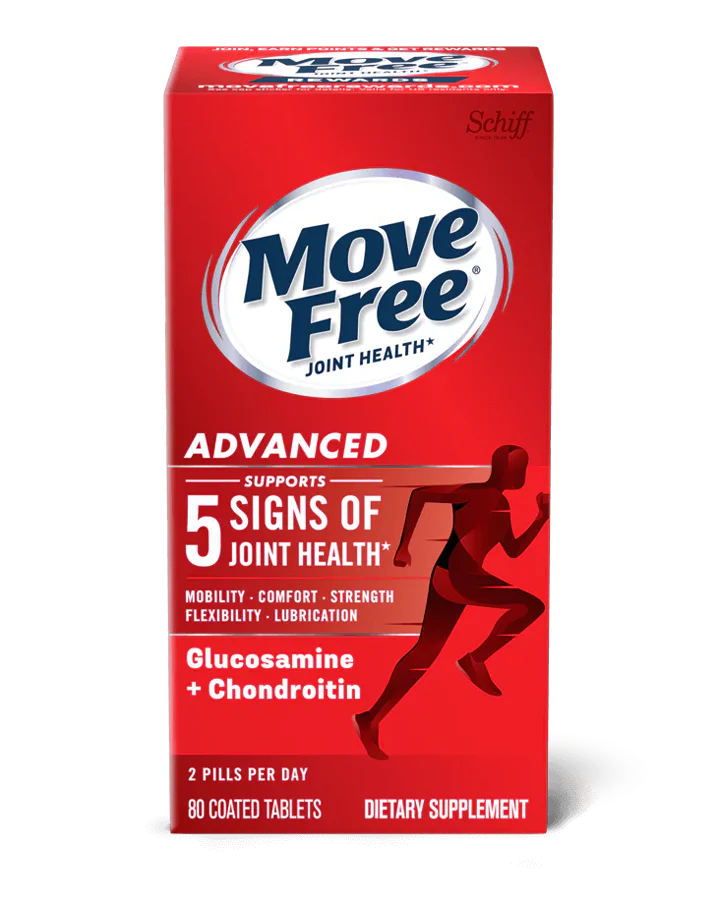
Move Free Advanced Joint Health Glucosamine Chondroitin
This is a real, widely-sold supplement from a named, publicly-traded manufacturer, and it carries a genuine third-party quality mark. That's the good news, and it's real. The more complicated news: the research behind its two headline ingredients is honestly mixed, not a clear win — and one of those ingredients is dosed well below the amount actually used in the research it trades on. Here's exactly what we verified.
What It Is
Move Free is a joint-support supplement line currently owned and sold by Reckitt, the publicly-traded UK consumer-health company also behind Mucinex and MegaRed. Reckitt acquired the brand's original manufacturer, Schiff Nutrition International of Salt Lake City, UT, in November 2012 for $1.4 billion, outbidding a competing $1.2 billion offer from Bayer. Schiff itself traces back further: it operated as Weider Nutrition International, founded by Joe Weider in 1936, before renaming to Schiff in 2005. In fairness to the historical record, that earlier Weider-era company settled FTC false-advertising complaints over unrelated weight-loss and muscle-building product claims in 1976, 1985, and 2000 — decades before Move Free's relevant marketing and about different products entirely. It's a real part of the corporate lineage, not a reason to doubt today's joint-health product, and we're not going to pretend it doesn't exist either.
The "Move Free" name currently covers several different tablet formulas — a base "Advanced" version, "Advanced Plus MSM," "Advanced Plus MSM & Vitamin D3," and an "Ultra Triple Action" version built around UC-II undenatured collagen rather than glucosamine and chondroitin at all. This review covers the base Move Free Advanced glucosamine-chondroitin-calcium fructoborate formula specifically — the numbers below won't match a different SKU's label, so it's worth confirming which version is in the bottle before comparing prices or doses.
What's Actually on the Label
Per labeled serving (two tablets, taken together once daily with a meal, or one tablet twice daily with meals):
- Glucosamine Hydrochloride — 1,500 mg
- Chondroitin Sulfate Sodium — 200 mg
- Calcium Fructoborate (the branded "Uniflex"/FruiteX-B® ingredient) — 216 mg
- Hyaluronic Acid — approximately 3.3 mg
Glucosamine in tablets like this is conventionally manufactured from crustacean shells (shrimp or crab), which is why the label carries a shellfish caution. That caution is a real, standard precaution rather than a documented hazard specific to this product — published challenge studies have found shellfish-allergic patients tolerating shrimp-derived glucosamine without reaction, likely because the allergenic proteins are largely absent from the processed shell extract. We're not telling anyone with a shellfish allergy to ignore their doctor's advice here; we're reporting the actual state of the evidence, which is more reassuring than the blanket warning label alone suggests.
Certification, Precisely: What "USP Verified" Actually Means
Move Free Advanced carries the USP Verified Mark, from the U.S. Pharmacopeia's Dietary Supplement Verification Program — confirmed current on retail listings as recently as this year. This is worth being precise about, because supplement certifications get lumped together in marketing when they're genuinely not interchangeable:
- USP Verified Mark (what this product has) means USP audited the manufacturing facility, reviewed quality-control documentation, and lab-tested product samples to confirm the tablet actually contains the ingredients on the label, in the stated amounts, doesn't carry harmful levels of specified contaminants, and dissolves properly. It does not mean USP tested or confirmed that the product relieves joint pain — quality assurance and clinical efficacy are two separate questions, and USP verification only answers the first one.
- NSF Certified for Sport and Informed Choice are different programs entirely, built for a different purpose: screening specifically for substances banned in competitive athletics. Neither appears on this product, and neither would be the relevant mark to look for here — this isn't an athlete-banned-substance concern, it's a general consumer-quality one.
- A bare "manufactured in a GMP facility" claim, seen on many supplement labels with no third party attached, describes a baseline legal requirement — the FDA already requires all U.S. dietary supplement manufacturers to follow Current Good Manufacturing Practices under 21 CFR Part 111. Stating it isn't a certification at all, since there's no independent audit behind the sentence. A verified USP mark is a real step above that bare claim, because an outside body is actually checking.
What the Research Actually Shows — and It's Genuinely Mixed
The most important study here is the NIH-funded Glucosamine/Chondroitin Arthritis Intervention Trial (GAIT), published in the New England Journal of Medicine in 2006. It randomized 1,583 people with knee osteoarthritis to glucosamine hydrochloride (1,500 mg/day), chondroitin sulfate (1,200 mg/day), the two combined, celecoxib (200 mg/day, a positive control to confirm the trial could detect a real drug effect), or placebo, for 24 weeks.
The honest headline result: across the full study group, neither glucosamine nor chondroitin, alone or combined, produced a statistically significant reduction in knee pain compared with placebo. The positive control worked as expected — celecoxib did significantly outperform placebo (about 70% of celecoxib patients had a meaningful pain reduction, versus about 60% on placebo) — which matters because it shows the trial design was sensitive enough to catch a real effect, and simply didn't catch one for glucosamine or chondroitin overall.
There was one more encouraging signal, and we're reporting it with the same caveat the trial's own authors gave it: in a pre-specified subgroup of 354 participants (22% of the total) with moderate-to-severe pain at baseline, the glucosamine-chondroitin combination did show a statistically significant benefit over placebo (about 79% responded versus about 54% on placebo). Because that subgroup was small, the researchers themselves described the finding as preliminary, needing confirmation in further study — and a follow-up analysis of the same cohort's X-rays over two years found no significant difference in joint-space narrowing (a structural measure of osteoarthritis progression) between any active treatment and placebo.
Research since GAIT hasn't settled the question cleanly either way. A widely-cited 2010 network meta-analysis in BMJ pooling 3,803 patients across multiple trials concluded that glucosamine, chondroitin, or the combination had no clinically relevant effect on pain or joint-space narrowing versus placebo. More recent 2018 meta-analyses complicate that picture rather than reversing it: one review found chondroitin taken alone helped with pain and function and glucosamine alone helped with stiffness, but the combined formula — the one actually sold in products like this — wasn't shown to outperform placebo; a separate pooled analysis of 29 trials and 6,120 patients found the same pattern, individual ingredients moving the needle on global pain while the combination didn't. NIH's own consumer-facing research summary on this describes the evidence overall as inconclusive, while still noting some people report meaningful relief, particularly for more severe pain.
Put plainly: this is not a supplement with strong, repeated proof that it relieves knee osteoarthritis pain for the average person. It's also not a supplement the research has ruled out for everyone — the one real positive signal (the moderate-to-severe pain subgroup) came from a well-designed, NIH-funded trial, even though it remains unconfirmed. Anyone telling you the science here is a flat "yes" or a flat "no" is oversimplifying a genuinely mixed literature.
Real Dosing vs. the Studied Doses
This is the specific gap worth knowing before you buy. GAIT — the trial this whole ingredient pairing is famous for — tested glucosamine hydrochloride at 1,500 mg/day and chondroitin sulfate at 1,200 mg/day.
Move Free Advanced's glucosamine dose lines up exactly: 1,500 mg/day of glucosamine hydrochloride, the same form and the same amount GAIT used. Its chondroitin dose does not: 200 mg/day on this label, against the 1,200 mg/day GAIT actually tested — a sixfold gap. If you're taking this product specifically because you read about the GAIT trial's combination results, it's worth knowing plainly that the chondroitin half of that combination isn't present here at anything close to the dose the trial studied. That doesn't necessarily mean the lower dose does nothing — chondroitin dose-response in humans isn't fully mapped — but it does mean this exact formula hasn't been the one tested in the trial its marketing implicitly leans on.
One more fairness note: other SKUs in the Move Free line carry different formulas and doses (the MSM and Vitamin D3 variants, for instance, add ingredients GAIT never tested at all). This chondroitin shortfall is specific to the base "Advanced" formula reviewed here — don't assume it automatically applies to every product carrying the Move Free name.
Who This Is — and Isn't — For
Reasonable to consider if: you have a physician-diagnosed case of knee osteoarthritis, particularly on the more moderate-to-severe end of the pain spectrum (the specific population where GAIT's one statistically significant signal appeared); you want a widely available, quality-verified product from a real, identifiable manufacturer rather than an anonymous online-only brand; and you go in understanding the evidence is genuinely mixed rather than proven.
Probably not the right pick if: you have a shellfish allergy and haven't cleared it with your doctor first, even though the reaction risk from processed glucosamine appears low in the available research; you take warfarin or another blood thinner — NIH's own consumer research center notes glucosamine and chondroitin may interact with warfarin, and the FDA's adverse-event database and published case reports document increased INR (a bleeding-risk measure) in patients combining the two, so this specifically calls for a conversation with your prescriber, not just a label read; or you're expecting fast, dramatic relief — even GAIT's positive subgroup result took the full 24-week study period to show up, and it's worth not confusing that timeline with the calcium-fructoborate ingredient's own separately-marketed "as little as two weeks" comfort claim, which comes from smaller studies on that one ingredient alone, not from the glucosamine-chondroitin evidence discussed above.
Where to Buy It
Move Free Advanced Glucosamine Chondroitin is sold directly through Amazon by multiple authorized retailers, in several bottle sizes. Amazon's own product-page infrastructure blocks the kind of automated check we'd normally do to confirm one specific listing's live price and stock at the moment you're reading this, so rather than link a single listing that might have changed, here's a live search for the exact product so you can see current listings, sizes, and prices yourself.
See Move Free Advanced on AmazonSources
- Clegg DO, et al. "Glucosamine, Chondroitin Sulfate, and the Two in Combination for Painful Knee Osteoarthritis." New England Journal of Medicine, 2006. pubmed.ncbi.nlm.nih.gov/16495392
- Sawitzke AD, et al. "The Effect of Glucosamine and/or Chondroitin Sulfate on the Progression of Knee Osteoarthritis: A Report from the Glucosamine/Chondroitin Arthritis Intervention Trial." Arthritis & Rheumatism, 2008. pubmed.ncbi.nlm.nih.gov/18821708
- NCCIH (National Institutes of Health). "Glucosamine and Chondroitin for Osteoarthritis: What You Need To Know." nccih.nih.gov
- NCCIH. "Osteoarthritis: In Depth" (warfarin interaction guidance). nccih.nih.gov
- Wandel S, et al. "Effects of Glucosamine, Chondroitin, or Placebo in Patients with Osteoarthritis of Hip or Knee: Network Meta-Analysis." BMJ, 2010. pubmed.ncbi.nlm.nih.gov/20847017
- "Effectiveness and Safety of Glucosamine and Chondroitin for the Treatment of Osteoarthritis: A Meta-Analysis of Randomized Controlled Trials." Journal of Orthopaedic Surgery and Research, 2018. ncbi.nlm.nih.gov/pmc/articles/PMC6035477
- "Effect of Glucosamine and Chondroitin Sulfate in Symptomatic Knee Osteoarthritis: A Systematic Review and Meta-Analysis of Randomized Placebo-Controlled Trials." 2018. pubmed.ncbi.nlm.nih.gov/29947998
- U.S. Pharmacopeia. "Dietary Supplement Verification Program" and "USP Verified Mark." usp.org
- Reckitt. "Move Free — Our Brands." reckitt.com
- Schiff Nutrition International, corporate history and 2012 Reckitt Benckiser acquisition. en.wikipedia.org/wiki/Schiff_Nutrition_International
- Knudsen JF, Sokol GH. "Potential Glucosamine-Warfarin Interaction Resulting in Increased International Normalized Ratio: Case Report and Review of the Literature and MedWatch Database." Pharmacotherapy, 2008. pubmed.ncbi.nlm.nih.gov/18363538
Talk to a healthcare provider before starting any new supplement, especially if you take blood thinners or have a shellfish allergy.
These statements have not been evaluated by the FDA. This product is not intended to diagnose, treat, cure, or prevent any disease.
As an Amazon Associate, American Wellness Daily earns from qualifying purchases.