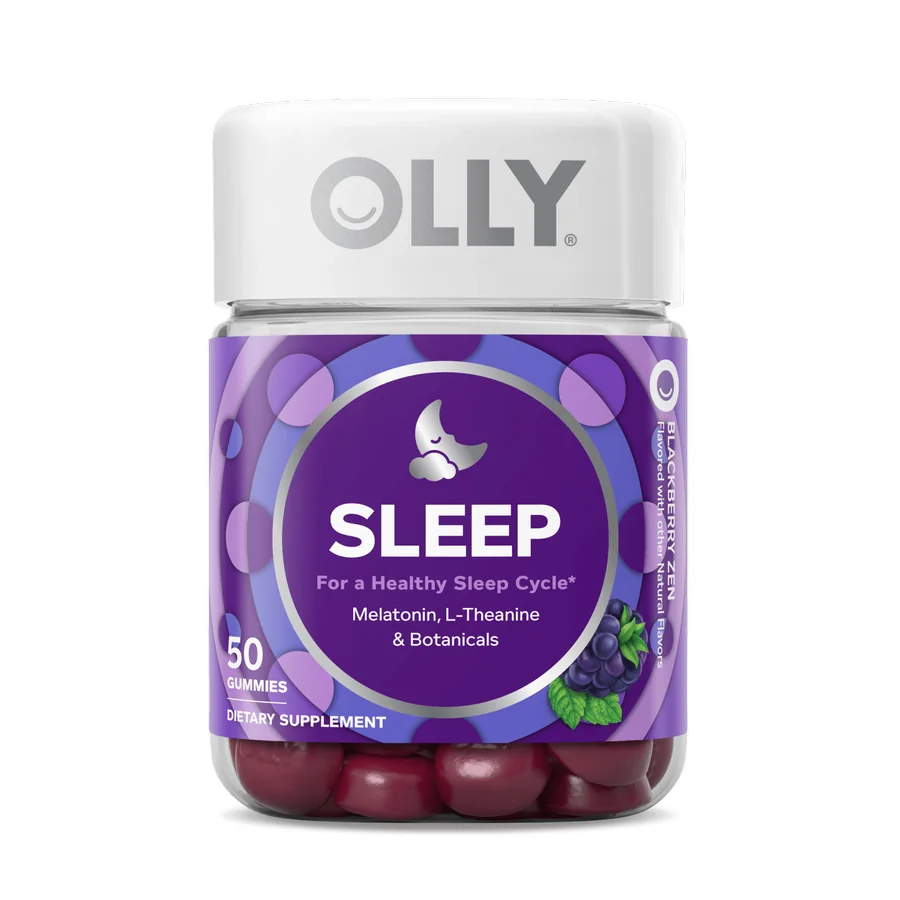
OLLY Sleep Gummies
A mainstream, widely-sold sleep gummy from a real, traceable manufacturer — so we checked whether the label holds up the way an anonymous DTC formula usually doesn't. Mostly, it does. Here's the one dosing detail that's still missing.
What It Actually Is
OLLY Sleep is a chewable gummy sleep aid, sold in a Blackberry Zen flavor, with a stated adult serving of two gummies taken about 30 minutes before bed. The active-ingredient side of the label is short and specific: 3 mg of melatonin, plus L-theanine, plus a botanical blend of chamomile, passionflower, and lemon balm extracts. We cross-checked that 3 mg melatonin figure across OLLY's own product page, its Amazon listing, and three separate retailer listings (Walmart, H-E-B, and Whole Foods Market) — all four sources state the identical 3 mg-per-two-gummies dose, which is exactly the kind of consistency we don't get to report on most of the DTC-funnel products we cover.
The inactive-ingredient list includes glucose syrup, beet sugar, water, gelatin, natural flavors, citric acid, coloring from carrot and blueberry juices, pectin, vegetable oil (coconut, canola), and carnauba wax. That gelatin is worth flagging plainly in the ingredients discussion, not just in the "who it's for" section below: this is not a vegan or vegetarian product, and OLLY doesn't market it as one.
The Certification, Precisely
OLLY's own retail listings describe the product as "NSF Certified," and we didn't just take that claim at face value. We pulled NSF International's own public certified-product database directly and found "SLEEP" listed as a certified product under NSF/ANSI 173 (NSF's dietary supplement standard), manufactured across four separate certified facilities. That's a real, independently-verifiable certification — not a vendor's self-issued badge.
It's still worth being precise about what that certification does and doesn't cover, because "NSF Certified" and "NSF Certified for Sport" are two different programs and get conflated constantly. Standard 173 certification means the finished product was tested to confirm the label's ingredient claims are accurate, and screened for heavy metals, pesticides, and microbial contaminants, on top of GMP-compliant manufacturing. NSF Certified for Sport is a separate, additional program layered on top of 173 that screens specifically for roughly 290 substances banned by major athletic organizations. OLLY Sleep carries the Standard 173 certification we verified — it is not marketed as, and does not carry, NSF Certified for Sport. That's not a knock on the product; it simply isn't positioned as an athlete-focused supplement, so the distinction is about reading the badge correctly rather than a shortfall.
We also confirmed OLLY is not an anonymous storefront. OLLY PBC was founded in San Francisco in 2014 by Eric Ryan (also a co-founder of the personal-care brand Method) and was acquired by Unilever in April 2019; it continues to operate under its own name with its own management. That's the kind of traceable corporate structure we can almost never confirm on the DTC supplement funnels that make up most of our Red Flag reports.
What the Research Actually Supports
Melatonin dosing has a real, counterintuitive research finding behind it worth knowing: several sleep-pharmacology sources report that adults naturally produce only about 0.1–0.3 mg of melatonin at the peak of nighttime production, and that doses in the roughly 0.3–3 mg range have performed as well as — or better than — much higher doses in comparative research, with some evidence that doses above 3 mg can increase next-day grogginess without improving sleep onset further. OLLY's 3 mg sits at the upper end of that lower, more physiologically-scaled range, and notably below the 5 mg and 10 mg doses common in many standalone melatonin bottles sold on the same shelf (OLLY itself sells Extra Strength and Maximum Strength versions at those higher doses separately, for anyone who wants them). A lower dose isn't automatically "weaker" here — for melatonin specifically, it may be the more evidence-aligned choice, not a compromise.
On gummy versus capsule absorption specifically: the pharmacokinetic literature we found indicates oral melatonin has roughly 15% bioavailability regardless of format, because it's subject to the same first-pass liver metabolism whether it arrives as a gummy, tablet, or capsule — format mainly shifts how fast the dose is absorbed, not how much of it ultimately gets into the bloodstream. The real format-specific risk with gummies isn't absorption, it's manufacturing consistency: a 2023 JAMA research letter (Cohen et al.) tested 25 melatonin gummy products sourced through the NIH's own Dietary Supplement Label Database and found 22 of them — 88% — contained melatonin outside 10% of their labeled amount, with actual content ranging from 74% to 347% of the stated dose. That study didn't publish which 25 brands it tested, so we can't say whether OLLY was or wasn't one of them, and we haven't independently lab-tested this specific product ourselves. What we can say is that this is exactly the failure mode NSF's Standard 173 certification is designed to catch — a third-party check on whether the bottle actually contains what the label claims — which is a real, relevant reason OLLY's certification matters more here than it might on a less exposed category of product.
The botanical side has genuinely uneven but real evidence behind each ingredient individually. Chamomile has the strongest human evidence of the three — a 2024 systematic review and meta-analysis pooling 12 randomized controlled trials found measurable improvements in sleep quality scores. Passionflower has support from a well-designed crossover RCT. Lemon balm's evidence is the thinnest of the three — a small 2011 pilot study found a 600 mg dose reduced insomnia scores by 42% versus baseline, which is a real but preliminary result, not a large confirmatory trial. Separately, L-theanine has its own systematic review of dietary-supplementation trials showing sleep-quality benefits (though not necessarily longer total sleep time) at doses in the 200–450 mg/day range studied.
Here's the one place the label falls short of full transparency, and it's the flagged chip above: OLLY's Supplement Facts panel lists "L-Theanine" and a "Chamomile, Passionflower & Lemon Balm" botanical blend without breaking out individual milligram amounts on any retail listing we could access. That means we can't confirm whether OLLY's L-theanine dose actually falls within the 200–450 mg/day range the sleep research above is based on, or how the botanical blend's total splits across three ingredients with three different strengths of evidence behind them. This is a real, checkable gap — not a serious red flag on the level of an undisclosed manufacturer or a documented complaint pattern, but a genuine dosing-transparency shortfall worth knowing about before you assume the gummy delivers a research-matched dose of everything on its front label.
Where to Buy It
Unlike our Red Flag reports, there's no reason to route you around this product's own listing — OLLY Sleep is sold directly through Amazon under its own name, at a verified, currently-live listing.
See OLLY Sleep Gummies on AmazonWho This Is — and Isn't — For
This is a reasonable fit for a healthy adult dealing with occasional, short-term trouble falling asleep who wants a lower, physiologically-modest melatonin dose alongside calming botanicals, in gummy form, from a manufacturer with a real name, a real ownership history, and an independently-verified certification behind it.
It's a poor fit for vegans or vegetarians, since the gummy base is gelatin, not a plant-based gelling agent. It's not the right pick for anyone who specifically wants a research-matched L-theanine or botanical dose, since those amounts aren't disclosed. Pregnant or nursing women, children (OLLY sells a separate Kids Sleep formula for that), and anyone taking blood thinners, immunosuppressants, diabetes medication, or seizure medication should talk to a doctor before starting any melatonin supplement, given documented interaction risks in that population. And melatonin in general is best treated as an occasional or short-term aid rather than an indefinite nightly habit — talk to a doctor if you find you need it every night for an extended stretch, since that can point to an underlying sleep issue worth diagnosing rather than masking.
Talk to a healthcare provider before starting any new supplement, especially if you are pregnant, nursing, taking other medications, or considering giving a sleep aid to a child.
These statements have not been evaluated by the FDA. This product is not intended to diagnose, treat, cure, or prevent any disease.
As an Amazon Associate, American Wellness Daily earns from qualifying purchases.
Sources
- NSF International, Certified Product Listings — Standard 173 (Dietary Supplements), OLLY / Company C0369077, checked directly against NSF's public database at info.nsf.org
- NSF.org and NSFSport.com program descriptions distinguishing NSF/ANSI 173 certification from the separate NSF Certified for Sport banned-substance-screening program
- OLLY PBC, product listing for "Sleep," olly.com/products/sleep
- Amazon.com listing, "OLLY Sleep Support Gummy Supplement, 3 mg Melatonin, L-Theanine," ASIN B07H8NZZJB, cross-checked against Walmart.com, H-E-B.com, and WholeFoodsMarket.com retail listings for the same product
- Cohen PA, et al., "Presence of Melatonin in Gummy Supplements Sold as Nutritional Supplements," JAMA (2023 research letter), as reported by outlets including WebMD, Forbes, and NutraIngredients
- NIH Office of Dietary Supplements, Dietary Supplement Label Database (dsld.od.nih.gov)
- Reporting on Unilever's April 2019 acquisition of OLLY PBC — Nutraceuticals World, Global Cosmetic Industry, and BeautyMatter
- Sleep-pharmacology literature on melatonin dose-response, including comparative low-dose (0.3–3 mg) versus high-dose findings summarized across peer-reviewed sleep-medicine sources
- Systematic review, "Examining the effect of L-theanine on sleep: a systematic review of dietary supplementation trials," Nutritional Neuroscience (2025), via Taylor & Francis Online
- Systematic review and meta-analysis of chamomile and sleep across 12 randomized controlled trials, ScienceDirect (2024)
- Pilot research on lemon balm extract and insomnia scores (2011) and crossover RCT evidence on passionflower and sleep, as summarized in peer-reviewed sleep-medicine literature