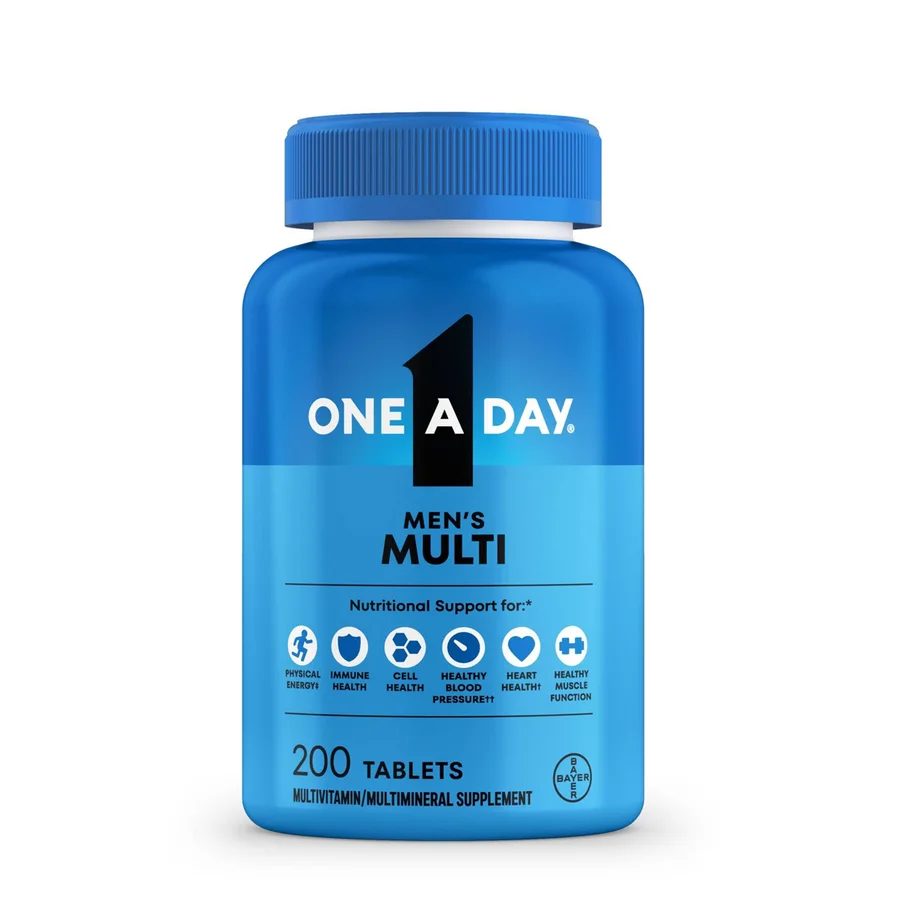
One A Day Men's Multivitamin
It's sold at every drugstore and warehouse club in the country for a few cents a tablet. We pulled the exact label Bayer filed with the federal government, checked all 22 nutrients against the NIH's own reference amounts, and confirmed which certifications this product actually carries — and which ones it doesn't.
What It Actually Is
One A Day Men's Health Formula is a one-tablet-daily multivitamin/multimineral supplement made by Bayer HealthCare LLC. It's not positioned, on its own label, as a performance or energy-boosting pill in any dramatic sense — the manufacturer's own filed claims are plain "structure/function" language: support for heart health, blood pressure already in a normal range, immune health, and helping convert food into usable energy through its B-vitamin content. That's a meaningfully more modest claim than a lot of what shows up in this category, and it's worth taking at face value rather than reading more into it.
The National Institutes of Health's own Office of Dietary Supplements describes exactly this category of product — a standard multivitamin/mineral (MVM) supplement — as something many people take as a form of "nutritional insurance": a way to help close small, everyday gaps between what you actually eat and what the reference intakes call for, not a replacement for eating reasonably well. NIH also flags a real, slightly counterintuitive wrinkle worth knowing: population data shows that people who already take an MVM tend to eat somewhat better than people who don't — so some of the "benefit" seen in observational research is tangled up with who chooses to take a multivitamin in the first place, not necessarily proof of what the pill itself does.
What's Actually On the Label
We didn't rely on marketing copy for this. We pulled the exact label Bayer filed with the NIH's Dietary Supplement Label Database (DSLD) — a federal government database that catalogs the literal Supplement Facts panel manufacturers submit — cross-checked it against the current listing sold under this name, and compared every nutrient to the specific Recommended Dietary Allowance (RDA) or Adequate Intake (AI) the NIH's Office of Dietary Supplements publishes for an adult man aged 19–50. One tablet contains 22 active ingredients; none of them are hidden inside a vague "proprietary blend" — every single one carries its own specific, disclosed amount.
| Nutrient | On This Label | Adult Male RDA/AI | % of RDA/AI |
|---|---|---|---|
| Vitamin A | 3,500 IU (14% as beta-carotene) | 900 mcg RAE | ≈115–120%* |
| Vitamin C | 60 mg | 90 mg | 67% |
| Vitamin D | 700 IU (17.5 mcg) | 15 mcg (600 IU) | 117% |
| Vitamin E | 22.5 IU (≈10.1 mg) | 15 mg | ≈68%* |
| Vitamin K | 20 mcg | 120 mcg (AI) | 17% |
| Thiamin (B1) | 1.35 mg | 1.2 mg | 113% |
| Riboflavin (B2) | 1.7 mg | 1.3 mg | 131% |
| Niacin | 18 mg | 16 mg NE | 113% |
| Vitamin B6 | 3 mg | 1.3 mg | 231% |
| Folate | 400 mcg folic acid | 400 mcg DFE | 100% |
| Vitamin B12 | 18 mcg | 2.4 mcg | 750% |
| Biotin | 75 mcg | 30 mcg (AI) | 250% |
| Pantothenic Acid | 16 mg | 5 mg (AI) | 320% |
| Calcium | 210 mg | 1,000 mg | 21% |
| Iron | 0 mg | 8 mg | 0% — deliberate |
| Magnesium | 140 mg | 400–420 mg | 33–35% |
| Zinc | 15 mg | 11 mg | 136% |
| Selenium | 110 mcg | 55 mcg | 200% |
| Copper | 2 mg | 0.9 mg | 222% |
| Manganese | 2 mg | 2.3 mg (AI) | 87% |
| Chromium | 120 mcg | 35 mcg (AI) | 343% |
| Lycopene | 300 mcg | no RDA set | — |
*A genuine wrinkle, disclosed honestly rather than smoothed over: Bayer's own DSLD filing expresses vitamins A, D, and E in International Units (IU), the older FDA labeling convention, so we've converted them using standard IU-to-RAE and IU-to-mg factors to line them up against the current RDA. Vitamin C is a clean, unit-free comparison, though — it's 60 mg on both of Bayer's own federal filings (2018 and 2020), while several current 2026 retail listings for this exact product describe a 99 mg vitamin C figure instead. We can't fully reconcile that from public sources alone; it's consistent with a formula refresh sometime after the last federal filing, but we're flagging it as an open discrepancy rather than picking whichever number makes for a tidier table.
A few things worth knowing rather than worrying about: this formula deliberately contains zero iron — sensible, since adult men (unlike menstruating women) rarely run an iron deficit, and unnecessary iron is one of the more common ways a multivitamin can actually cause harm in a household with small children. Magnesium sits at less than half the RDA, which isn't a defect so much as a physical reality — the NIH itself notes magnesium is one of the nutrients Americans most commonly under-consume, and fitting a full 400+ mg dose into a single tablet alongside 21 other ingredients isn't realistic. Chromium runs at over 3x the AI, but the NIH ODS fact sheet on chromium notes no Tolerable Upper Intake Level has been established for it at all, due to its low observed toxicity — so that headroom isn't a red flag. Iodine and potassium aren't included at all, which is standard for this product category; potassium's own RDA (3,400 mg for men) is physically too large to fit in a tablet, and multivitamin iodine inclusion varies by brand.
Who Actually Makes It — and What Its Certifications Really Mean
One A Day was introduced in 1940 by Miles Laboratories and is now owned and distributed by Bayer HealthCare LLC, 100 Bayer Boulevard, Whippany, NJ 07981 — a real, named, easily verified consumer-health division of a large multinational company, not an anonymous DTC storefront. The federal DSLD filing lists a working consumer phone line (1-800-800-4793) and states the product is "Made in the USA of US & imported materials." That's about as traceable as a manufacturer gets in this category.
Here's where certification precision actually matters, and where we want to be exact rather than generous: like every dietary supplement legally sold in the US, this product is required under federal law (21 CFR Part 111) to be produced in an FDA-registered facility following dietary supplement Good Manufacturing Practices. That's a real, meaningful baseline — but it's a floor every legal product in this category has to clear, not a distinguishing seal. It is not the same thing as NSF Certified for Sport (a banned-substance screening program aimed at competitive athletes, irrelevant to a general multivitamin), Informed Choice/Informed Sport (the same category), or USP's own Dietary Supplement Verification Program — a voluntary, paid, third-party testing program that confirms a specific batch actually contains what the label says, in the amounts stated, without harmful contaminant levels.
We checked USP's own current list of Verification Program participants directly. It's a short list — roughly 20 brands, including Nature Made and Kirkland Signature/Member's Mark — and One A Day / Bayer does not appear on it. That doesn't mean this product fails any specific test; Congress made USP compliance voluntary for dietary supplements under the 1994 Dietary Supplement Health and Education Act, and plenty of otherwise solid, mainstream products simply haven't paid for that specific third-party audit. But "made in a GMP-compliant facility" and "USP Verified" are two different, non-interchangeable claims, and we'd rather say plainly that this product carries the first one and not the second than let the two blur together.
What the Research Actually Shows
The honest, current answer is: modest and mixed, not proven and dramatic — which is a fair description of the whole everyday-multivitamin category, not something specific to this one product. The 2022 U.S. Preventive Services Task Force recommendation statement, drawing on 84 studies including several large randomized trials, concluded that the evidence is currently insufficient ("I" statement — not a recommendation for or against) to weigh the benefits and harms of multivitamin use for preventing cardiovascular disease or cancer in the general population.
One study inside that evidence base deserves a fair, specific mention: the Physicians' Health Study II, a large randomized, double-blind, placebo-controlled trial, found an 8% reduction in overall cancer incidence among the male physicians who took a daily multivitamin over more than a decade. It's a genuinely well-designed trial and one of the more encouraging signals in this literature — but the USPSTF itself flags the obvious limitation: it studied male physicians specifically, a health-conscious, high-education population that doesn't necessarily generalize to everyone. It's real evidence of a modest possible benefit, not proof this specific product prevents cancer, and we're not going to stretch it further than that.
Who This Is — and Isn't — For
A reasonable fit: someone who wants inexpensive, broad-spectrum coverage for the ordinary nutritional gaps in a typical American diet, doesn't already take a separate iron supplement or eat a heavily fortified diet, and isn't looking for anything beyond what the label actually claims — general nutrient support, not a performance or energy transformation. At a real-world price of roughly a few cents a tablet, it's hard to beat on cost for what it delivers.
Probably not the right fit: anyone on blood-thinning medication like warfarin, since this formula's Vitamin K content can interact with how those drugs work — Bayer's own label carries the caution "not a replacement for heart medications," and this is exactly the kind of interaction worth a two-minute conversation with a pharmacist or physician before starting. It's also not the right product for someone who already eats a diet fortified with cereals, energy bars, and other supplemented foods — several of the B-vitamins here already run at 100–750% of the RDA on their own, and stacking that against other fortified sources is how someone ends up genuinely over the top on niacin, B6, or folic acid, which NIH's own multivitamin fact sheet specifically warns can happen.
Where to Buy It
We link directly to the product itself here — Bayer's identity, address, and manufacturing claims all check out, and nothing about this listing raised the kind of red flags we look for in this category.
See One A Day Men's Multivitamin on AmazonSources
- NIH Office of Dietary Supplements, Dietary Supplement Label Database (DSLD) — Bayer One A Day "Men's Health Formula," Label IDs 178058 and 239391, distributed by Bayer HealthCare LLC, Whippany, NJ
- NIH Office of Dietary Supplements, Multivitamin/mineral Supplements — Fact Sheet for Consumers
- NIH Office of Dietary Supplements, individual nutrient fact sheets (Vitamin A, C, D, E, K, B-complex, Calcium, Iron, Magnesium, Zinc, Selenium, Copper, Manganese, Chromium) — RDA/AI/UL reference values for adult men
- US Preventive Services Task Force, "Vitamin, Mineral, and Multivitamin Supplementation to Prevent Cardiovascular Disease and Cancer: Recommendation Statement," JAMA, June 2022
- Physicians' Health Study II, as summarized in the USPSTF's 2022 evidence review
- U.S. Pharmacopeia (USP), Dietary Supplement Verification Program — current list of participating brands
- Wikipedia, "One A Day" — brand history (Miles Laboratories, 1940; current Bayer ownership)
Talk to a healthcare provider before starting any new supplement, especially if you take blood-thinning or heart medication.
These statements have not been evaluated by the FDA. This product is not intended to diagnose, treat, cure, or prevent any disease.
As an Amazon Associate, American Wellness Daily earns from qualifying purchases.